Chapter 3: Kathmandu
Training
 The path I was on was called the "Baglung Road" by the other teachers at the school. It was actually more a
dream of the possibility of a road, not a road as I understood the word. At first, the roadway was a simple, slightly
worn path down the center of a narrow, flat
field. After a few hundred feet, it evolved into a
dirt walkway nestled between walls of stone or the dirt retaining walls of
terraced fields. Often, the road was a
simple, flat surface that interrupted the steep hillsides. The trail’s stony
surface was firm and flat, crushed and compacted from years of travelers. It was occasional marred where seasonal streams
eroded shallow channels across it. Trudging along the road between barren,
stepped fields, I saw that the trail, following the natural contours of the
hillside, gently winding its way upward through a grove of bamboos and into a
forest of sparse trees and mountain laurel.
Within the woods ahead jutting out from among green foliage, was the thatched
roof, whitewashed upper walls and porch of a lone house. It perched on a small ledge interrupting the
steeply plunging hillside. Far below
were the cliffs of the gorge and its raging river hundreds of feet below.
There was a more
direct route northward from where I lived.
To go that way, I would cross the parade grounds in front of the school
and take the main road up the hill to the alcove of the communal water supply. A
partially hidden path just beyond and behind the watering station threaded
itself through a grove of trees to the terraced fields beyond. As soon as the path emerged from the trees, it
became the top edge of a field’s retaining wall only as wide as a man’s
shoulders. From there, the narrow pathway looped around a dozen small fields of
all shapes sizes, dropping down two levels to a slightly wider footpath that
skirted the edge of the dense jungle above.
From there, the trail followed the hill’s curvature, undulating in and
out with the terrain. The trail
eventually led into

a densely wooded area, passing above where I first stayed. Inside
that forest, the path twisted and turned through stands of trees, bamboo
thickets and dense underbrush. Along the
way were a myriad of side roads and alternative pathways.
A few hundred feet into the jungle, a path branching from the main
trail led out of the trees, across a surprisingly gentle pasture and into to a
remote, secluded oasis of trees and bushes.
Within that copse was hidden a cool spring of water and the promise of some
privacy. One of the challenges I faced
was keeping comparatively clean. Soon
after arriving at Balewa, I had established a daily routine of using lye soap
and cold water from my earthen jug to wash my face, arms and feet. I reserved the sterilized and filtered water
for cooking, drinking and brushing my teeth.
Most weekends, I
stripped naked and wrapped a large cloth around my waist and upper legs –
pulling the end through my legs and tucking it in. Then, grabbing my soap and towel, I headed
for the local spring in hopes of getting clean. I tried to bathe by imitating how the local
men washed themselves in the afternoon. They
would strip down to their loincloth, crouch in front of the iron pipe and clean
themselves, carefully washing each segment of the seven-stranded cord they never
took off. The cord was an important part
of their daily life, positioned differently for different activities. Once satisfied that each strand was clean,
they finish their ritual by reaching under their loincloth to take care of the
unseen. Unfortunately, every time I
tried to wash, a crowd of women gathered to stare at the tall, red-haired, white
foreigner. My embarrassment and
self-consciousness kept me from spending the time or effort I needed to bathe
effectively. I also needed to wash my
clothes without an audience.
When I shared my
need for more privacy with one of the Nepali teachers, he told me about the
wonderful oasis of privacy on the other side of the hill. It was a long walk, and any time I sat down,
I had to fend off legions of leaches from my feet, but it was worth the
trip. I found the privacy I need to get
fully clean. An added bonus was the
opportunity to wash my one set of clothes, and wait for them to dry while
sitting around wrapped in my cloth. It
was during one of my irregular visits there that I discovered lice in my hair,
which I eventually treated with DDT.
At another junction, the side trail took me to a small enclave of
buildings set within the jungle. There, I
encountered a large extended family struggled to operate their newly built teashop.
Sitting on the shop’s steps was a forlorn
woman holding a small, infant girl on her lap.
The listless child’s head lolled backward and flies crawled across her
unseeing eyes and into her open mouth. I
could do nothing. My feeling of helplessness was overwhelming and the horrible
scene indelibly etched itself into my memory, returning, unbidden, in my dreams.
There were many different ways to
travel, and the jungle road offered many destinations – including a dismal path
leading to the cold, silent clearing of a local witch doctor.
When travelling
alone, I preferred to take the longer route to Baglung. There were more people along the way, more
rest stops and the road was more open. I
also knew that there were fewer dangers along a well-traveled road and less
chance of making a wrong turn. Trudging
along that convoluted, twisting road to the woods above, I continued mentally
reviewing my first days in Nepal and our training in Kathmandu.
The first evening
at the hotel in Kathmandu, we joined our in-country Peace Corps trainers for
dinner. We ate in a long, narrow room on
the first floor. A row of windows facing
the courtyard gave us a wonderful view of the enclosing wall. A massive, wooden table dominated the room. It
was in the center of the room and stretched from wall to wall. The table’s patina, intricately carved legs
and style gave it both a sense of age and value. Surrounding the grandeur of the table,
marching arm-to-arm down both sides, were matching, straight-backed
chairs. The table and chairs completely
filled the room with the backs of the seats only inches away from the walls. Glistening white bone-china plates elegantly
graced each place setting, complimented by white linen napkins, clear,
cut-glass water goblets and heavy, silver flatware. Parading down the center of
the table were a half-dozen large, silver serving dishes piled high with an
unidentified entrée of raw, ground meat artistically garnishing with sprigs of
fresh green spices. Many, smaller dishes
of white rice and unrecognizable sautéed vegetables encircled the massive
plates of meat. The hotel staff heard a
rumor that Americans ate meat and had done their best to present a Western
style meal.
We knew the meat
could not have been beef since cows were sacred, but we never discovered what
kind of meat it was. Fearing all the
terrible things that could happen from eating raw meats, most of us ate only the
rice and the more familiar vegetables. Our
trainers recommended that we not drink the tepid, iceless water and stick to
hot tea or bottled beverages. No one
complained. Few of us felt hungry, and our excitement at finally being in Nepal
overshadowed any problems we had with our first meal. We spent most of the evening sitting around
that massive table talking, joking and laughing about our recent adventures in
flying. Even though a few Volunteers did
taste the red, gooey meat, and drank the water, no one became ill. It was apparent that someone may have spoken
to the staff about our difficulties; after that first night, the meals served
to us at the hotel were less formal, less extravagant, less daunting, fully
cooked and more recognizable.
The next day, our
training continued as we met together in the hotel’s lobby. As a group, the trainers led us as we walked
a short distance from our lodging to a nearby construction site. The partially built structure we would use
looked like a three story metal skeleton.
It was missing the outer walls and the floors were unfinished, pitted cement.
Rusting, bare steel beams and decaying
surfaces suggested that the work on the building had stopped some time
before. Although I saw a number of
openings that appeared to be for staircases, there were no stairs, only ladders
stretching up to the second floor.
Each morning, we
walked the few blocks to the construction site. There, we stood around the gravel courtyard
waiting for our trainer. When they
arrived and divided us into study groups, we climbed the rickety bamboo ladders
to our assigned, open-to-the-air rooms on the second floor. Usually, we used
three of the rooms for our classes.
Sitting on an old, folding metal chair positioned just a few feet from
the missing outer wall, I struggled to keep up with our morning language
classes. The trainers used large pads of white paper propped on a stand
with the morning sun glaring off the dull surface. Like our hotel, a cement wall surrounded the
construction site and, although the trees and large bushes just inside deadened
most of the street noises and gave us some sense of privacy, we still needed to
speak very loudly for others to understand. Our language classes met until noon and, much
to my relief, we had an hour for lunch. Most of us took advantage of the food provided
by our hotel, but a few, brave volunteers ate at a restaurant adjacent to where
we were staying.
We usually returned to the “skeleton building” after lunch to
continue our studies of Nepal’s history, culture, and traditions. The curriculum included field trips to nearby
points of interest and excursions to small communities outside the city. Our
structured learning ended in the late afternoons and we had a few hours of free
time. I used mine to explore the bazaars
looking for adventure in a city with cows wandering the streets, fruit bats
hanging from

trees, marijuana plants towering over sidewalks and feral dogs
roaming around for food. At night, the
dogs hunted in packs. The roads I wandered often led to round, domed-shaped
temples topped with rectangular cupolas painted with huge eyes on all four sides. No animal was to be put to work within sight of those eyes. Above
the eyes were tall, central spires with long strings radiating in all
directions. Attached to each were
multitudes of rectangular prayer flags. I fequently visited the eyed Buddhist Bhagwati temple.The largest and most ancient Hindu temple I discovered in my wanderings was the Swayambhunatha Stupa. Encircling it was a wall sporting an array of
different carvings splashed with bright colors of paint, banks of carved prayer wheels, gongs of different sizes and cups for burning incese or candles.
On another street, I found a frightening,
multi-armed idol depicting a god adorned with a necklace of human skulls and
girded by a belt from which hung bloody, detached, human arms. It stood guard
over freshly presented, bright
yellow and red offering. Some idols I found in partially hidden in alcoves
along residential streets. The trainers
told me that they were probably private, family worship areas. Often, the idol within a recess was of
Ganesh, a chubby elephant-headed god that supposedly removes obstacles of life.
During some of my excursions, I encountered ragged bands of men
playing strange, whining, atonal music on square, three-stringed, long-necked
instruments. These men were often accompanied by others using highly dented,
dull metal horns. Frequently, a musician
would be twirling a highly embossed metal can affixed to the end of a
handle. Inside was a prayer written on a
piece of paper and each rotation sent it to god. A
surprisingly rich and mellow sound emanated
from these bands, and the donations given to them were generous.
As I aimlessly wandered
the streets of Kathmandu, I discovered many immense, unused buildings. Some of the smaller, modest structures were empty governmental buildings,but others belonged to the powerful political
families that had been overthrown when the king regained power in a daring
maneuver involving cars, planes and deception.
The elaborately ornate larger edifices had
massive, overhanging eaves
braced with richly carved wooden supports depicting events in the Vedas or explicit
and risqué scenes that leave nothing to the imagination. A trainer told me that most of the carving on
roof supports depicted scenes from the Kama Sutra.
While walking along
many of the suburban streets I passed towering poppy plants and cows lying in
the street chewing their cud. Garbage rotted in the gutters while beggars held
out their hands for money while sleeping fruit bats hung from the trees next
to them. Everywhere there were emaciated
mongrel dogs festooned with lumps, sores and dangling tumors. I
spotted them skulking down darkened alleyways or asleep on the streets. Fortunetellers,
sitting cross-legged on the sidewalk at an intersection near our hotel, plied
their mystical arts with enthusiasm and conviction. With their astrological charts and tables strewn
about them, they eagerly told people their futures – for a price.
Each afternoon I
ventured further away from the safety of our hotel discovering a variety of stores,
temples and street vendors. On some days, I wandered the streets before our classes
began. It was during one of my early
morning outings that I saw men selling fresh yogurt in unglazed clay bowls. They
carried dozens of their red-brown bowls stacked inside rope cradles suspended at
each end of wooden yoke carried across their shoulders. Our trainers warned us not to eat any yogurt
from street vendors because the many crunchy, black bits suspended throughout
it were neither raisins nor nuts. When flies and other insects became stuck on
the yogurt’s skin, the peddlers simply stirred the struggling insects back into
the bowl content.
Other hawkers offered unusually colored drinks in strange, clear
glass bottles. The bottles had long
necks with spherical bulges their mouths.
The carbonation within a bottle’s liquid pressed a ball in the bulge
upward with enough force to seal the opening.
A customer opened their drink using a lever mechanism secured around the
neck to force the ball down and out of the way.

There were many
important places near our hotel including the Peace Corps Headquarters. To get there I walked down the street from
our hotel and a few blocks later turned left onto a wide, important boulevard. On the way, I passed the King’s Palace. It was an impressive, white mansion festooned
with statues, fountains and a large, fabricated lake in front. One trainer shared a story about a massive,
million-dollar, clear crystal chandelier and the difficulties works had
installing it. Every time I saw the
palace, I wondered about the size and location of such a huge fixture. Just
past the mansion was another, smaller road leading to a poorly maintained
back street. A short way down that street was our headquarters.
The Peace Corps
Headquarters consisted of two principle buildings inside a walled enclosure. At
the entrance was an old, western style two-story house for volunteers to gather,
relax and swap stories about their experiences at their station. That house was a favorite place for those working
in the city to socialize and help new volunteers adjust to living in a strange
place. One major problem that each of us
needed help with was the very real reality of “Culture Shock.”
On the first
floor, diffuse sunlight filtering through a bay window on the street side provided
sufficient lighting for most of the day to read. It was a surprisingly cozy environment of miss-matched
wooden chairs, overly worn lounge chairs and a dank smelling, faux leather
couch in front of the window. There, we often exchanged precious books that
covered all genres of interests including science fiction, classic novels,
philosophy and cooking. At times, we
would also play card games around a small, badly marred coffee table. The house had a distinct, musty smell of
mildew, aging wood and decaying books, occasionally overpowered by the aroma of
rotten eggs emanating from an unfortunate victim.
When the common dysentery of Giardia, a protozoan parasite, afflicted a
volunteer they would ostracize themselves for the duration of their suffering.
Even with the smells and dim lighting, the house was a haven where we socialized,
helped each other, shared our troubles and talked about home. We could always find the comfort and support
we needed.
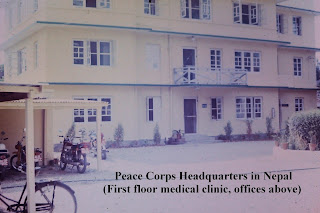
The gravel driveway of the Peace Corps Headquarters curved around and
behind our little house to the small parking area in front of the main
building. It was a much newer, well
cared for three stories high cinderblock structure. On the first floor was a
small clinic that provided for the medical needs of volunteers. Past the reception area was an examination
room, a small infirmary, and a modest lab staffed by a nurse and Doctor
Small. The doctor and I spent
considerable time together playing chess, eating together at western
restaurants, and talking about Physics, diseases and interpreting X-ray images.
One time he challenged me to examine an
image and tell him what was significant.
Somehow, I did not notice an entire arm was missing.
Near the clinic’s
reception desk was a stairway leading to the second floor landing and a short
hallway leading to the various administrative offices. Walking down that passage felt like a piece
of America. Its dimensions, design and décor
provided a haven of Americana for the administrators and visitors. Large
pictures of an illegal mountain climbing expedition embellished the walls
directly outside the director’s office.
Earlier that year, a Peace Corps Volunteer had climbed Dhawalagiri
Mountain, but had not obtained permission from the Nepali government to climb
nor had paid them for the privilege of climbing. Although officially reprimanding
him and requiring that he pay the National Mountain Climbing fees and the associated
fines and penalties, the volunteer was openly praised for his heroics. The pictures of his exploits adorned the
hallway and were a shrine to his adventure.
There were other,
smaller buildings inside compound for supplies, personal storage and the care
of vehicles. Parked under various
shelters were single-speed bikes for the volunteers to use instead of walking
or hiring a taxi. Since the Headquarters
was only a short walking distance to the American Embassy, King’s Palace, many
westernized restaurants and a variety of hotels and shopping areas, very few of
us used the bikes.
At night, the Peace
Corps Headquarters was empty and silent.
The administrators and staff that worked there had permanent homes of
their own. One afternoon I discovered a little oasis of western life and
comfort while visiting the Director’s home. He had a small staff of hired help that
maintained his lavish home and life style.
Some of them acted as servants, ready and eager to do the Director’s
bidding while others were cooks and housekeepers. It strongly reminded me of movies depicting
white-clothed aristocrats maintaining their entitled lifestyles in the middle
of third-world poverty. At the time, I
did not realize how significant his running water, indoor plumbing and
electricity was even in Kathmandu.

One favorite haunt within walking distance of the hotel was the
bazaar area of Durbar Square. Every day, purveyors displayed colorful arrays of
fresh produce, lumps of bloody meat, and other goods of all descriptions. Peddlers spread their offerings on the ground
or stacked them on temporary stands. They often waved choice items with their
dirty hands to prospective buyers. Around the perimeter of the square, tucked
into cubbyholes and glass-fronted stores, were the more permanent shops. While
walking around in the bedlam of sellers and buyers taking in the sights, I
noticed many people had disturbingly black mouths and teeth. The black
discoloration was the telltale sign of an addiction to chewing leaf-wrapped
beetle nuts.

A young woman and her daughter made and sold these addictive
packages from a small recess along an alleyway leading away from the square. I
easily identified most of the foods in the bazaar but some of the fruits and
vegetables had odd shaped, weird coloring or the wrong size for what they
appeared to be and I did not recognize them. It was during my visits to the bazaar that I
honed my bargaining skills by buying a more familiar item from one of the less
aggressive sellers. Unfortunately, my haggling ability always seemed to suffer
from my inexperience and poor language skills. Every time I made a purchase, I felt
cheated and the seller was elated.
Near Durbar square with all its people and chaotic activity was Hanuman
Dhoka, or “Monkey Gate,” I knew it as a large, very ornate building with a
massive, carved doorway sometimes

protected by an armed guard. When asked about the history or significance
of the “Gate,” our trainers never gave me a satisfactory explanation. The
Nepali men within the “Gate” gave even more confusing responses when I asked using my poorly mastered Nepali. Because of its size and central location,
Hanuman Dhoka became a familiar landmark I used to keep myself orientated
while exploring the maze of alleys and passages around the bazaar. One narrow
alley across the square from Hanuman Dhoka led to a cheap and friendly hostel
used by visiting Peace Corps Volunteers. Next to the hostel, an inexpensive
teashop offered a variety of foods. I frequently encountered people from India,
China, Germany and other countries there to help Nepal and its rush to develop
or tourists seeking a new experience. One
night, while chatting with two engineers from China, I learned about some of
China’s political interests in the area and sensed their enthusiasm to build
roads.
Near the hostel
was a narrow street dedicated to the needs of mountain climbers. It bustled with Sherpa, aspiring foreign
adventurers and tourists looking for souvenirs. Experienced
volunteers assured
me that I would need a compact, climber’s kerosene stove, small cooing kit and
wooden matches and this street was where to buy them. Most volunteers were stationed in large
villages
where they lived in apartments located over stores, restaurants or
other businesses and usually cooked their own meals or ate at a local
restaurant. Volunteers stationed in
smaller towns lived with host families who provided a room and plenty to
eat. Even living with a host, having the
ability to cook western-style meals was a blessing. I knew I would be glad to have the stove and
pots with me.
Every new turn and alley revealed something new to me. Kathmandu was kaleidoscopic mixture of beliefs,
practices, behavior and cultures. Buddhist
priests wearing orange robes mingled with Hindus, Muslims and the faiths of the
tourists from many nations. Hindu and
Buddhist statues, shrines and temples populated every street, and religious
demonstrations including processionals were a common event as were wandering
sacred cows, feral dogs, Fortune Tellers, beggar, tradesmen and an occasional
Holy Man.
Outer, low walls of stone and cement surrounded many of the round-shaped
temples and some had wrought iron fencing encircling them. Within the framework of the fencing were cups
where devout worshipers lit candles or oil lamps and burned pieces of
paper. It was my understanding that the
paper had prayers on them that the flames sent to the god they worshiped.
At one temple, I
watched a woman go down on her knees as if
genuflecting, but her decent
continued until she was lying prone on the ground. Then she stood up, taking a step forward in
the process, and repeated the sequence.
I do not know how long it took for her to go completely around the temple
nor how many times she made the trip. I
thought of this woman when I learned that Martin Luther, before he nailed his ninety-five
theses to the chapel door, circled the church on his knees. I saw religious icons, buildings and
activities everywhere I roamed. Some
people spun prayer wheels, others hit cymbals or bells and many people offered
sacrifices. Everyone worshiping
seemed to
chant. Returning to the hotel, I
wondered about how my own American culture and Christian beliefs filtered my
observation and often felt guilty about letting my own Bible readings lapse
while in training. There were so many
demands and distractions that every night I fell into bed exhausted.
Part of our training was a total immersion experience,
which I dreaded as soon as I heard about it.
On that feared day, three of us joined a trainer in one of the
Headquarters’ cars and drove us up into the hills north of the city. The first place he stopped appeared to be a
typical farmhouse where a congenial man, clasping his hands together as if
saying a prayer, greeted us with a hearty “Namaste.” He then shook the trainer’s hand and, after
introductions, greeted the volunteer we were leaving at his house. As we drove away, I turned and watched the
two of them chatting amiably as the host led his guest into his house. The idea was that, after a brief stay with a
host who did not know English, we were to find our way back to the hotel only using
our Nepali language skills. Our gracious
hosts would give us directions in Nepali and we could seek additional help as
we walked home. I thought, “If this was a ‘typical’ family, there was nothing
to fear.” Instead of feeling anxious, I
began to look forward to meeting my host.
After dropping off the other volunteer at a
homestead very much like the first, the trainer and I continued up the hillside. Seeing the farmer at the second farm greeted
us the same way as the first man had, I stopped worrying about my return. The trip from the second house was long,
involved and confusing. Eventually, we stopped at a comparatively large estate
protected by two large, ferocious dogs.
Wanting to return to the city immediately, the trainer assured me that
someone would be there and left me. I
waited, but after a long time I realized that no one was home. I was alone without food or water. The only other living things were two large,
snarling, snapping dogs tied up a few feet away from me. Lost, I started walking back to Kathmandu by
following the way the trainer had left.
I was greatly encouraged to keep going by the monstrous, terrifying dogs
behind me. A few hundred feet away from
the farm, the beasts behind me were satisfied with my progress and happily lost
interest. I then slowed my pace and
considered my situation.
Trudging along
the dirt road, I vaguely remembered some of the turns and twists we had taken on
our drive up. I reasoned that, when in
doubt I would always choose to take larger roads leading downward. Plodding
along, I rehearsed in my mind how I would ask directions in Nepali, and
reviewed the possible answers. After a
few hours, I easily found my own way back to the outskirts of the city. Unfortunately, the labyrinth of narrow,
twisting streets ahead totally confused me.
I had to depend on my language skills to get home.
When I finally reached
the paved roads of Kathmandu, I started asking strangers for directions to the
hotel. After a few disastrous attempts
at communication, I realized that very few people even knew of the hotel and
those who had heard of it did not know where it was. After one confusing exchange, I decided to
ask how to get to the King’s Palace. Once
I was near the Palace, I knew I could find my way. There
was another obstacle to my success – most of the people I asked talked so fast
and used so many unfamiliar words that I did not understand what they were
saying. Often, I only understood the
directions through mutual pointing and gestures. By late afternoon I finally meandered
into familiar territory and, after recognizing a familiar recessed idol of
Shiva, I knew my way home. It was
evening and becoming dark when I finally walked up to my room. The other volunteers had returned hours
before.
It was not long after
my ordeal that the Kathmandu part of our training was finished. Before the deployment to our stations, we
still needed specific teaching experiences using our language skills. For the final phase of our preparation for
service, we would practice different teaching methods in supervised classroom
at a school close to our final destinations, which would remain unknown until
all training aspects were completed.
During this final part of training, each of us would live with a host family
and fully experience Nepali life. Half the remaining volunteers would serve in
the eastern part of the country while the rest would be west of Kathmandu. A few days before we were to leave, I sought
advice from experienced volunteers. They
warned me that the Nepali were highly suspicious of We
sterners and thought
anyone from America with a radio and camera was a CIA operative.
On their advice,
I left my radio, camera and most of my clothes in a locker at the Peace Corps
Headquarters. I took only my basic needs
packed into an aluminum-framed backpack: the medical kit assigned to me, a
sleeping bag, a few clothes, toiletries, my Bible, language books, flashlight,
iodine tablets, candles, matches, camp stove, compact cooking kit and canteen.
I left behind my precious new radio, camera equipment, and most of my clothes.
Eight other volunteers and I flew out of
Kathmandu in an old, well cared for DC10 heading westward to Pokhara. Although I knew the others in the group, my
closest friends from training were on another flight going east. Taking to the air, the others on the plane
grouped together with their friends leaving me alone. I listened as they shared anecdotes about our
training, excitedly talked about their possible assignments and keeping in
touch with each other. Sitting next to a
small, round portal alone and frightened, I stared out at the range of blocky,
snow-covered mountains to the north. Looking northeast toward Sagarmatha, all the
peaks appeared to be the same height and I realized that I still did not know
which of the white lumps Mount Everest was. During the next hour or so, I
studied the jagged, forbidding shapes of the Himalayan range and watched as their
rugged foothills unfolding beneath me.

Scarring the undulating terrain below were hundreds of small,
terraced fields that paraded up the hillsides in rounded, irregular steps. Traces of well-worn dirt paths wound between
the fields as it intersected clumps of trees, little brown houses, and other,
dusty walkways. Some of the terraces had blankets of new green growth while
others were flooded with water. Most of the fields were dirty brown plots dry
and devoid of life. Thin, black streams of water flowed down between the
terraces twisting around rocky crevasses and merging into each other in their
rapid decent. Although out of sight, I
knew the flows would quickly grow into rivers cascading to the valleys far
below.
My thoughts suddenly
snapped back to the present when I walked around one of the hill’s sharp curves
and entered the edge of the forest. A few steps in and spindly trees, thick mountain
laurel and scattered clumps of bamboo surrounded me. The pathway was dry, compacted and barren as
it wound itself around outcroppings and larger rocks. Nearby, I heard loud chirping of startled
birds and rustling in the underbrush. I knew
I would soon be at an ancient rest area on top of a knoll with its large
“Peepal Tree” providing shade and protection to weary travelers. On the other side, the roadway broadened into
an easier to walk pathway bordered with low walls of stone bordered it.


